How is shell money jewellery made?
Alison Wishart··5 min read
Share
Share
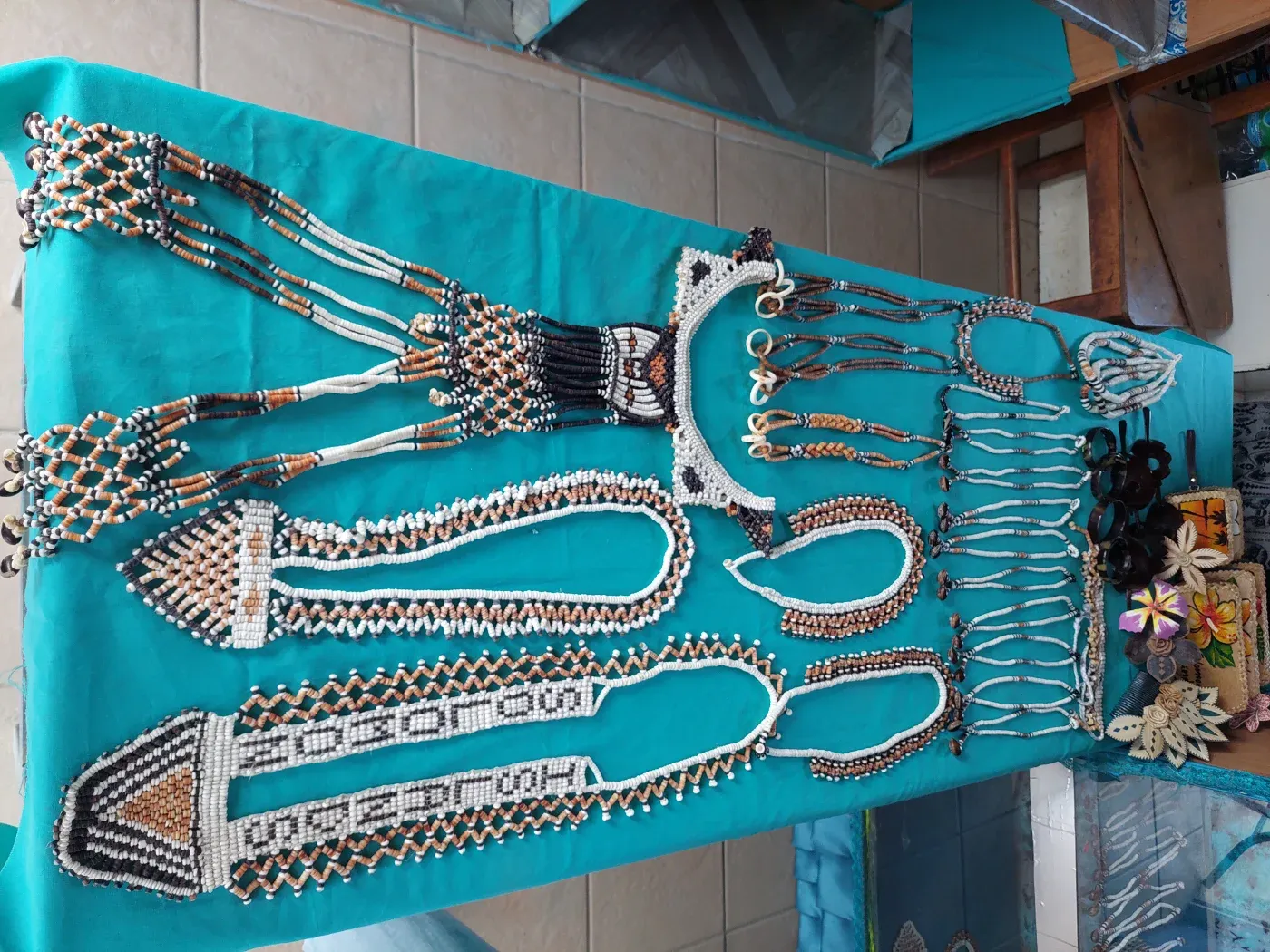
Shell money (Tafuliae)
Shell-money is a form of currency that originates in Langa Langa Lagoon, Malaita, the most populous island in the Solomons archipelago.
The shells are fashioned into small beads and threaded into long strands of shells of a uniform colour. Traditionally, these strands are given as part of a ‘bride price’ – that is, the price that a man would pay to purchase his bride. Iro and Claydent illustrate the bride price ceremony in their contemporary painting, which is in the National Art Gallery.
Today, the bride’s family will give the groom’s family the equivalent amount back in foods such as taro, yams, rice and pigs, so that the tradition of using shell money is maintained, but it is no longer a way of buying a woman.
[Bride Price], 2023, David Iro and Claydent, 163cm H x 290cm W
Langa Langa Lagoon is the shell money mint for the Solomons. Here’s the process that was demonstrated to me.
1. Collect a range of shells and sort them by colour and type. The darker coloured shells are rarer and therefore more valued - like the higher denominations of a currency.
2. Break the shells into small pieces (about the size of those forgotten Australian 1 cent pieces) using two rocks and chip off any sharp edges. Children are taught to do this too, and they start with the more common shells. The pieces are collected in halved coconuts.
3. Sand the shells between two softer rocks using a paste made of water and ochre. This removes the grooves on the back of some seashells.
4. Drill a small hole in the centre of the shell without cracking it. The traditional method is to use a drill bit made from a tiny piece of very hard stone which is sharpened to a point (like the one identified by the arrow in the photo) and embedded into a shaft of wood. The wood and stone are turned very quickly – the drilling motion – by pulling up and down on another piece of wood that is perpendicular to the shaft and moves a string attached to and wound around the vertical piece of wood (I’m not an engineer so my grasp of this is limited). Suffice to say, it is ingenious and very difficult to operate. Today, people use a hand drill, which speeds up the process threefold.
5. Gently bake some of the grey shells on a heated stone so that they change to a pink-red-orange colour. This is the most valuable coloured shell money, because it is the rarest. Shells of the same colour are then threaded onto a long piece of nylon – a string of bush vine was used in the past.
6. Place the long strand of shells into a groove that has been chiselled into a length of wood and using water and a specially shaped stone, sand the sides of the shells to make them rounder, smooth and uniform in size and shape. Traditionally, this was the only part of the process that was the man’s job.
7. The strands of shell money are now complete and ready to be given away as part of the bride price. In addition, they are often used to make shell money jewellery that is acquired and worn by locals and tourists, men and women alike! Hours and hours of work go into making enough shells for a necklace. The red/pink shells are six times the price of any other colour but, like many artforms, the price doesn’t reflect the skill and time involved.
Shell money jewellery is also a badge of identity, particularly for people from Malaita. In 2025, the United Nations International Court of Justice recently ruled that countries do have a legal obligation to mitigate the effects of climate change that often has a profound effect on countries with the lowest CO2 emissions. This photo shows Solomon Islander, Cynthia Houniuhi, who comes from south Malaita, wearing a headband and necklace made of shell money as she presents her case to the International Court of Justice.
Cynthia Houniuhi, President of the Pacific Islands Students Fighting Climate Change, speaks during the public hearings on the request for an advisory opinion on States' obligations regarding climate change, held at the International Court of Justice, The Hague, Netherlands, 2 December 2024. Credit: UN Photo/ICJ-CIJ/Frank van Beek. Used with permission.
Alison Wishart
Editor
Share